
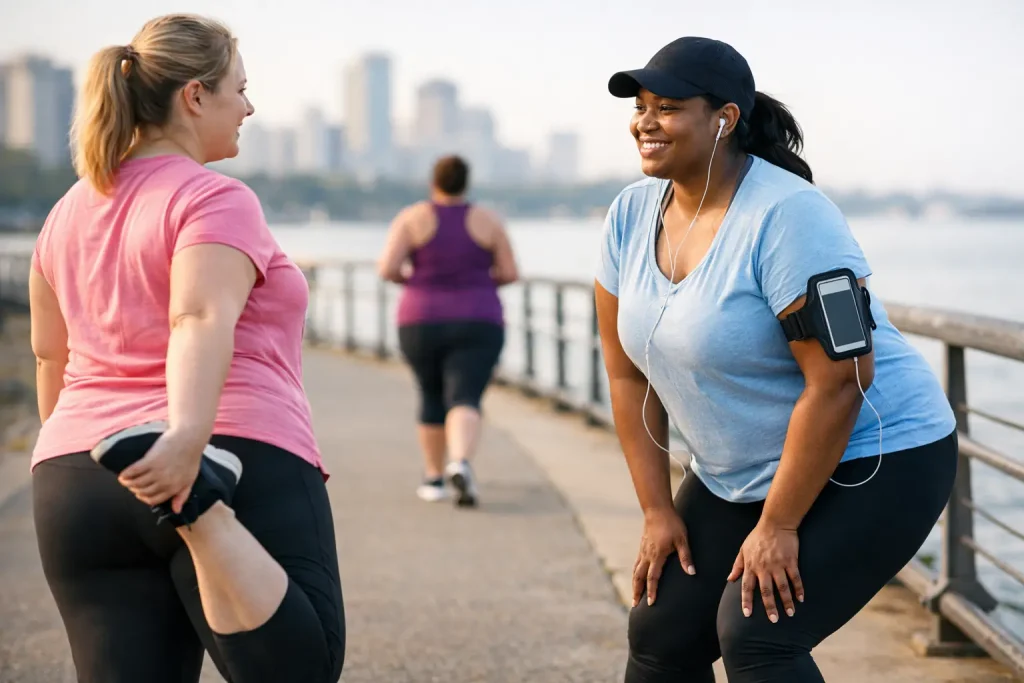
Some people worry about their knees before they even leave the house. Others worry about being seen. If you are thinking about running in a larger body, both concerns can feel loud before you have taken a single step.
That does not mean running is off limits to you. It means you may need an approach that is gentler, more flexible, and more realistic than the plans often pushed online. You do not need to prove toughness. You do not need to run through discomfort. You do not need to shrink first. You need a starting point that respects your body as it is now.
Running in a larger body starts with less than you think
A lot of beginner advice still assumes a certain level of confidence, fitness, or body comfort. It often jumps straight to running continuously, as though walking is only a stepping stone to get past quickly. For many people, that approach is simply too much, too soon.
Starting with walking and short running intervals is not a compromise. It is a sensible way to let your muscles, joints, breathing, and confidence adapt together. If you have not run for years, or ever, your body needs time to get used to the impact. So does your mind.
This is especially true if you are carrying old experiences with you – PE classes, comments from other people, failed plans, or the feeling that running belongs to someone else. Those things matter. They shape how safe or unsafe starting can feel.
A kinder beginning often looks like this: a brisk walk for a few minutes, a very short jog, then walking again before you are exhausted. Repeating that a handful of times is enough. It counts. More than that, it works.
What makes running feel harder in a larger body
Some challenges are physical. More body mass can mean higher loading through the feet, ankles, knees, and hips with each step. That does not mean damage is inevitable, but it does mean pacing and progression matter. Recovery matters too.
Some challenges are practical. It can take time to find comfortable clothing, supportive shoes, or a sports bra that does not make the whole experience miserable. Chafing can become the thing that ends a session before fitness does. Heat can feel harsher. Hills can feel relentless.
And some challenges are emotional. You might feel exposed, even if nobody is paying much attention. You might assume other runners are judging your pace, your shape, or your walk breaks. You might worry that if you cannot run for long, you are not doing it properly.
All of that is real. None of it means you cannot become a runner.
How to begin running in a larger body safely
The safest place to start is below your maximum, not at it. That means keeping early sessions short enough that you finish feeling like you could have done a bit more.
A simple example is 20 to 25 minutes total, with a warm-up walk first. After that, try 20 to 30 seconds of easy jogging followed by 90 seconds to 2 minutes of walking. Repeat that for the rest of the session. If that feels too much, shorten the running part. If it feels manageable, stay there for a while before changing anything.
The biggest mistake beginners make is not that they walk too much. It is that they progress before their body is ready. One good week can tempt you to double everything. Usually, that is when niggles start.
Try giving yourself two or three sessions a week, with rest days in between. Rest is part of training. So is repeating the same week more than once. If your legs feel unusually heavy, your joints are sore in a way that lingers, or your energy is flat, it is fine to keep things steady.
A flat route can help early on. So can a quiet time of day, a local oval, or a short out-and-back route close to home. The best route is not the most scenic one. It is the one you are willing to return to.
Form, comfort and impact
You do not need to overthink technique, but a few small adjustments can make running feel less jarring. Keep your effort easy enough that you could still say a sentence. Think short, light steps rather than long bounding ones. Let your arms swing naturally and keep your shoulders relaxed.
If something feels awkward, slow down. Often the answer is not to push through but to reduce the intensity. Running slower can lower the overall strain and help you stay more in control.
Comfort matters more than people admit. If your bra, shorts, underwear, socks, or shirt are rubbing, riding up, or making you self-conscious, that will affect whether you go out again. The same goes for shoes. You do not need the most expensive pair, but you do need a pair that feels stable and comfortable for walking and gentle run-walk sessions.
Chafing is common and not a sign that you are doing anything wrong. It is just a practical problem to solve. Softer fabrics, well-placed anti-chafe balm, and shorter early sessions can make a big difference.
What to expect in the first few weeks
You may notice your breathing improves before your legs feel fully on board. Or your confidence may come before your stamina does. Progress is often uneven like that.
Some days will feel surprisingly good. Others will feel clunky for no obvious reason. Weather, sleep, stress, hormones, work, and general life all affect how a session feels. That does not mean you are going backwards.
You may also find that walking remains a regular part of your running for quite a while. That is not failure. Plenty of people build a solid running habit through walk-run intervals and keep using them because they work well.
This is where a walking-first mindset helps. Instead of asking, “How soon can I run without stopping?” it can help to ask, “How can I make this sustainable enough to come back next week?” That question usually leads to better decisions.
Dealing with fear of judgement
For many people, this is the hardest part of running in a larger body. Not the effort itself, but the feeling of being watched.
It can help to remember that most people are busy with their own thoughts. And the people who matter – the ones who understand what it means to start from where you are – are not measuring your worth by your pace.
Still, reassurance does not always switch fear off. So make it easier. Start in a place where you feel less visible. Go at a quieter time. Wear clothes that help you feel secure rather than exposed. Take headphones if they help you settle, or leave them at home if you feel safer staying aware of your surroundings.
If outdoor running feels like too much at first, begin with walking and short jogs in a park, on a treadmill, or even by repeating a small loop near home. Confidence often grows after evidence, not before it.
In communities like Runners Gateway, this kind of beginning is normal. People start where they are, use walk breaks, repeat weeks, and build up slowly. That matters, because feeling less alone can make it easier to keep going.
When to pause and adjust
Not every discomfort is a warning sign, but not every ache should be ignored either. General muscle soreness that settles is common when you are starting. Sharp pain, limping, swelling, or pain that worsens during or after each session deserves more caution.
If something does not feel right, shorten the next session or swap it for a walk. You do not lose progress by adjusting early. Often you protect it.
The same goes for energy. If you are returning after illness, burnout, injury, or a long break from exercise, your capacity may change from week to week. Meeting yourself there is not lazy. It is wise.
A gentler goal that still moves you forward
If running feels emotionally charged, make your goal smaller. Not “become a runner”. Not “run 5K without stopping”. Just complete two short walk-run sessions this week. Or put your shoes on and walk for ten minutes, with one or two easy jogs if you feel up to it.
Small goals are not less serious. They are often the reason people keep going long enough to improve.
You are allowed to start with caution. You are allowed to be slow. You are allowed to build this in a body that does not match the usual running image. Today can be as simple as a ten-minute walk, one gentle jog between two power poles, and the quiet decision to try again another day.
If you want a low-pressure place to begin, Getting Started keeps the first step realistic, and the Community helps you feel less alone in it.