
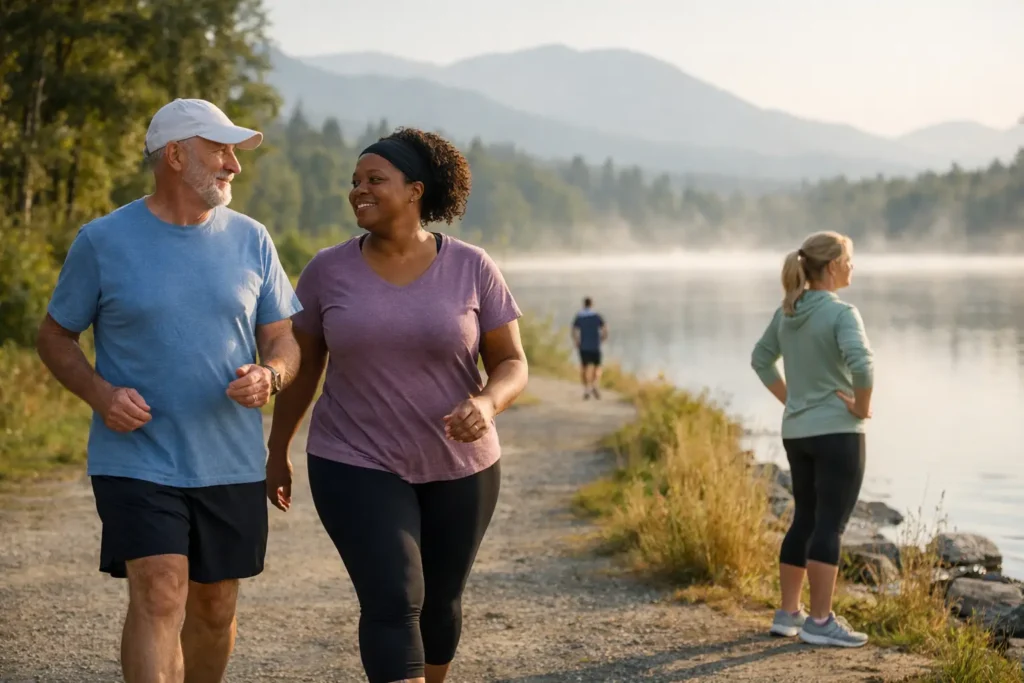
There is a moment many new or returning runners know well. You head out meaning to do something good for yourself, start jogging, feel uncomfortable within a minute or two, then assume the problem is you. Too unfit. Too heavy. Too old. Too slow. But if you are wondering how to enjoy running slowly, the issue is often not your ability. It is the idea that running only counts if it looks a certain way.
Slow running can feel awkward at first, especially if you have spent years seeing running presented as hard, fast, and relentless. Yet for many ordinary people, slow running is the version that actually makes running possible. It gives your body time to adapt, gives your mind room to settle, and makes it far more likely that you will come back and do it again.
If this is your first step back into movement, Getting Started can help you make it small enough to repeat.
Why slow running often feels harder than it should
A strange thing about running slowly is that it can feel emotionally harder than running fast. Not because the effort is greater, but because it asks you to let go of what you think a runner should look like.
If you are returning after injury, illness, burnout, pregnancy, weight gain, or simply a long stretch of life getting in the way, slow running can bring up a lot. You may feel exposed. You may worry people are judging your pace. You may compare yourself to a past version of you, or to every confident runner who glides by without seeming to sweat.
That mental noise can make a gentle run feel heavy before your legs have even warmed up.
The practical side matters too. Many people try to run every run at a pace that is just a bit too hard. Not a full sprint, but hard enough that breathing feels ragged, posture tenses up, and the whole thing becomes something to endure. When that happens, slow running never gets the chance to feel good because you are not actually going slowly enough.
How to enjoy running slowly without feeling like you are failing
The first shift is simple, but not always easy. Slow running is not a lesser version of running. It is running done at a level your body can currently handle.
That might mean a shuffle. It might mean short running intervals with walking in between. It might mean covering less distance than you hoped. None of that makes it fake. In fact, it often makes it more sustainable.
Enjoyment usually starts when pressure drops. If every outing is a test of fitness, pace, or willpower, your body learns to brace against it. If each outing is allowed to be manageable, your body and mind can start to trust the process.
Try replacing performance questions with gentler ones. Instead of asking, How far did I go? or Was I quicker than last time? ask, Did that feel manageable? Could I do that again in two days? Did I finish feeling punished or steadier?
Those questions lead you towards a running habit you can live with.
Let your breathing set the pace
One of the easiest ways to slow down enough is to pay attention to your breathing rather than your watch. If you can say a short sentence out loud, or at least breathe without that panicky edge, you are probably in a more suitable range.
If you cannot, ease back. And if easing back still feels too hard, add walking. That is not a step backwards. It is often the smartest way forwards.
A walk-run approach helps many beginners enjoy movement sooner because it keeps effort from building too quickly. You get little pockets of recovery before things unravel. That can be the difference between finishing feeling capable and finishing convinced that running is not for you.
Stop treating walking as a failure
This one matters more than people realise. If every walk break feels like proof that you are not doing it properly, you will carry frustration through the whole session.
Walking is not the opposite of running. For beginners and returning runners, it is often part of the run. It helps manage effort, supports recovery, and makes consistency more realistic.
Plenty of people enjoy running more once they stop fighting this. A session of one minute running and one or two minutes walking can feel far better than trying to force ten straight minutes and ending up miserable. Over time, those gentle repeats build confidence and fitness in a way that all-or-nothing efforts rarely do.
Make slow running feel nicer in real life
Enjoyment is not only about mindset. It is also about reducing the small things that make running feel unpleasant.
Choose a route that feels low pressure. That might be a quiet street, a local oval, a flat path, or even a short out-and-back near home so you never feel stranded. Busy areas can make some people self-conscious, especially early on. There is nothing wrong with making it easier on yourself.
Time of day matters too. Some people feel best heading out early before the day gets noisy. Others do better later, when the morning rush is over and their body feels less stiff. It depends on your life, energy, and confidence. The best time is the one you are most likely to repeat.
It also helps to start smaller than your ambitions. If your energy is low, tell yourself you are going out for ten or fifteen minutes, not a full proper run. A short, gentle session still counts. Often the hardest part is getting out the door, not the running itself.
Wear what helps you relax
You do not need a dramatic kit overhaul, but comfort helps. If something rides up, rubs, pinches, or makes you feel too exposed, it can take up far too much mental space. The more settled you feel in your clothes and shoes, the easier it is to pay attention to the run rather than your discomfort.
This is especially true for people rebuilding confidence. Sometimes enjoying slow running starts with removing one annoying distraction at a time.
Give yourself a different goal
If your goal is to become the sort of person who can run comfortably a few times a week, slow running makes sense. If your goal is to prove something every time you head out, it will always feel frustrating.
A useful goal for this stage is rhythm. Not speed, not distance, just rhythm. You are learning how to move in a way that fits your current body and life.
That may mean repeating the same short walk-run session for two or three weeks. It may mean backing off after a rough night of sleep or a stressful work week. It may mean realising that twenty minutes done gently is better for you than thirty minutes done in a state of dread.
This is where many people quietly make progress. Their runs do not look impressive from the outside, but they become less dramatic, less punishing, and more familiar. That is often when enjoyment begins.
Expect some runs to feel ordinary
Not every slow run will feel calm, freeing, or satisfying. Some will feel flat. Some will feel clunky. Some will feel harder than they should for no obvious reason.
That does not mean slow running is not working.
Adults juggling work, family, interrupted sleep, stress, recovery, and changing health are not machines. Your body will respond differently from week to week. When you expect every run to feel good, normal variation feels like failure. When you expect some runs to be merely okay, you leave room for a steadier relationship with running.
This is one reason community matters too. In spaces like Runners Gateway, slower progress, walk breaks, repeated weeks, and uneven confidence are treated as normal. That can be a relief when the wider running world makes it seem like everyone else is charging ahead.
A gentle way to start enjoying running slowly
If you want to make this practical today, keep it very simple. Head out for 15 to 20 minutes. Alternate an easy jog with walking, using whatever ratio feels manageable – even 30 seconds running and 90 seconds walking is fine. Keep the effort low enough that you finish feeling you could have done a bit more.
Then notice one thing that felt better than expected. Maybe your breathing settled. Maybe the walk breaks helped. Maybe you did not dread every minute. That small shift matters, because enjoyment rarely arrives as a big breakthrough. It usually appears as a quieter thought: I could do that again.
And that is enough. Slow running does not need to impress anyone to be worthwhile. It only needs to feel possible, kind enough to return to, and steady enough to fit into your real life.