
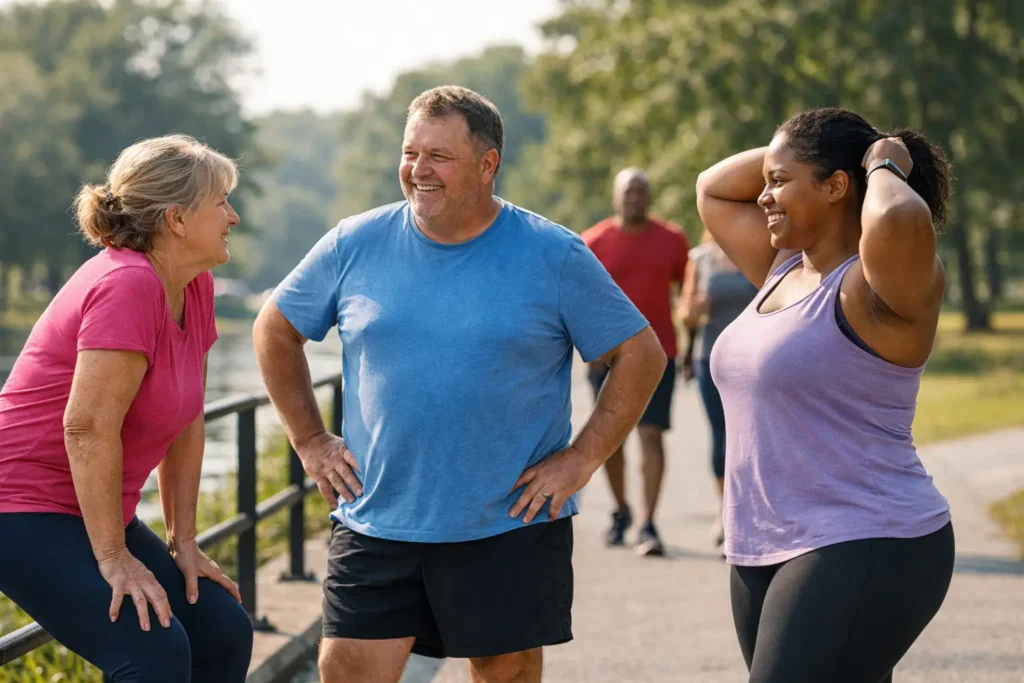
Most people worrying about jogging in public are not actually worried about jogging. They are worried about being seen trying. Puffing a bit. Going slowly. Taking walking breaks. Looking like a beginner. If you are searching for how to jog without embarrassment, that fear usually comes from feeling exposed, not from doing anything wrong.
That matters, because the answer is not to somehow become fitter before you start. It is to make starting feel safer, smaller and more normal. You do not need to earn the right to jog outdoors. You just need a way in that feels manageable.
If you are deciding where to begin, Getting Started gives you the gentle Runners Gateway doorway into this.
Why jogging can feel embarrassing in the first place
A lot of adults come back to movement after years away from it. Sometimes that gap is caused by injury, illness, work stress, parenting, low energy or simply life becoming crowded. Then the moment you consider jogging again, it can feel like everyone else knows what they are doing except you.
There is also a strong image problem around running. Plenty of running content makes it look polished, fast and effortless. Real beginner running is rarely like that. Real beginner running often includes red faces, uncertain pacing, stops at odd moments and plenty of walk-run intervals. That is not failure. That is what starting looks like.
Embarrassment often eases once you stop expecting yourself to look experienced. You are allowed to look new at something you are new to.
How to jog without embarrassment when you feel self-conscious
The most helpful shift is this one: try to make your first goal feel private, even if you are in public. You are not out there to perform. You are out there to complete a small session that supports your health and confidence.
That might mean jogging for 30 seconds, then walking for 90 seconds. It might mean leaving the house for ten minutes and coming back before your mind has time to turn it into a big event. It might mean repeating the same short route until it feels familiar.
Small sessions reduce embarrassment because they reduce pressure. When you are only aiming to do a few gentle intervals, there is less room for that all-or-nothing thinking that says you must look capable the whole time.
Walking breaks help as well. They are not something to hide. They are one of the most practical ways to begin safely and calmly, especially if your fitness is low or you are returning after a long break. A walk-run approach gives you a reason to slow down before you feel flustered. That alone can make public jogging feel much less stressful.
Pick conditions that make it easier, not harder
Confidence grows faster when you remove avoidable friction. You do not need the toughest setting to prove this counts.
Choose a time of day when the area is quieter if that helps. Early morning, later evening or the middle of the day can feel less exposed than school drop-off time or a busy Saturday morning. Pick a route with enough space that you do not feel boxed in. A quiet street, local oval, park path or wide footpath is often easier than a crowded shared path.
It can also help to start close to home. If you feel uncomfortable, you know you are never far from finishing. That sense of escape matters more than people realise.
Some people feel better wearing a cap, sunglasses or a simple outfit they do not have to think about. Not because you need to hide, but because reducing self-consciousness is useful. If one small change helps you leave the house more easily, it is worth doing.
Give yourself permission to look like a beginner
This is where many people get stuck. They think embarrassment will disappear once they move well enough, look fit enough or jog continuously. Usually it starts to fade earlier than that, when they stop treating beginner signs as evidence of failure.
Breathing harder than you would like does not mean you should not be there. Going slowly does not mean you are doing it badly. Alternating jogging and walking does not mean you are not a real runner. It means you are using a sensible starting point.
If it helps, think about what other people actually notice. Most passers-by are focused on their own day. The few who do notice you are unlikely to be analysing your form, pace or intervals. And if someone happens to see you taking a walking break, they are simply seeing a person exercising. That is all.
The harsher audience is usually the one in your own head.
Make the first few outings almost too easy
A common mistake is trying to outrun embarrassment by doing more. If you push too hard, you feel more breathless, more visible and more discouraged. Then the next outing feels bigger and harder.
Instead, make your early sessions deliberately gentle. You should finish thinking, I could do that again. That feeling is far more useful than dragging yourself through one difficult effort.
A simple starting point might be a five-minute walk to warm up, then six rounds of 30 seconds of easy jogging and 90 seconds of walking, followed by another five-minute walk home. That is enough. If even that feels too much, cut it down. Two or three rounds still count.
This gradual style is a big part of why walking-first plans work. They lower the emotional barrier as much as the physical one. You are not trying to prove anything. You are teaching your body and mind that this is safe to repeat.
Have a plan for awkward moments
Part of confidence is knowing what you will do if things feel uncomfortable.
If you see someone you know, you do not need a clever explanation. A simple smile or quick hello is enough. If you need to stop and walk because you feel puffed, stop and walk. That is not a public mistake. It is just part of the session.
If you feel overly visible in one spot, change the route next time. If a certain time is busier than you expected, try another. If music or a podcast helps you stay in your own lane, use that. If it makes you less aware of your surroundings, skip it. This is one of those it depends situations. The best choice is the one that helps you feel calm and safe.
You can also rehearse a simple thought for when self-consciousness spikes: I am allowed to start like this. That sentence can steady you when old shame starts getting loud.
Let consistency matter more than confidence
Many people assume they need to feel confident before public jogging becomes easier. Usually the opposite happens. Confidence comes after a few ordinary sessions where nothing dramatic happens.
You go out. You jog a little. You walk a little. You come home. Then you do it again a few days later.
That repetition is what changes the story in your head. Jogging stops being a big public test and starts becoming something you do. Not perfectly. Just regularly enough that it feels familiar.
This is also why missed sessions do not need to derail you. If work gets hectic, your sleep is poor or your energy drops, shorten the session rather than scrapping the whole idea. Ten minutes counts. A walk with one or two short jogs counts. Keeping the habit alive matters more than forcing a full session when life is already heavy.
If embarrassment is linked to past setbacks
Sometimes the fear is not only about being seen. It is about remembering previous attempts that ended in injury, exhaustion or disappointment. That kind of embarrassment can sit deeper because it carries a story of I have failed at this before.
If that sounds familiar, try separating this attempt from the old one. You do not need to prove you can do what you once did. You only need to begin from where you are now.
That may mean more walking than jogging. It may mean repeating the same week several times. It may mean choosing comfort and consistency over progress that looks impressive on paper. That is not settling. That is building something you can keep.
For many beginners and returners, having a gentle structure helps. That is part of why communities like Runners Gateway can feel reassuring. Slower starts, walking breaks and uneven progress are treated as normal there, not as something to apologise for.
A better question than how to jog without embarrassment
Sometimes a more useful question is: how can I make jogging feel less exposing this week?
The answer might be choosing a quieter route, shortening the session, using walk-run intervals or going out at a time when you feel less observed. It might be telling yourself in advance that walking is part of the plan, not a sign that you have fallen short.
You do not need to wait until you feel fearless. You only need a version of starting that feels kind enough to repeat.
If today is a low-energy day, make it very small. Put your shoes on, walk for five minutes, and try one gentle jog between two power poles. If that is all you do, it still counts. And sometimes that is exactly how confidence begins.
If embarrassment is keeping you indoors, Fear of Running in Public? How to Start Gently has more support for easing into outdoor running without making it a performance.