
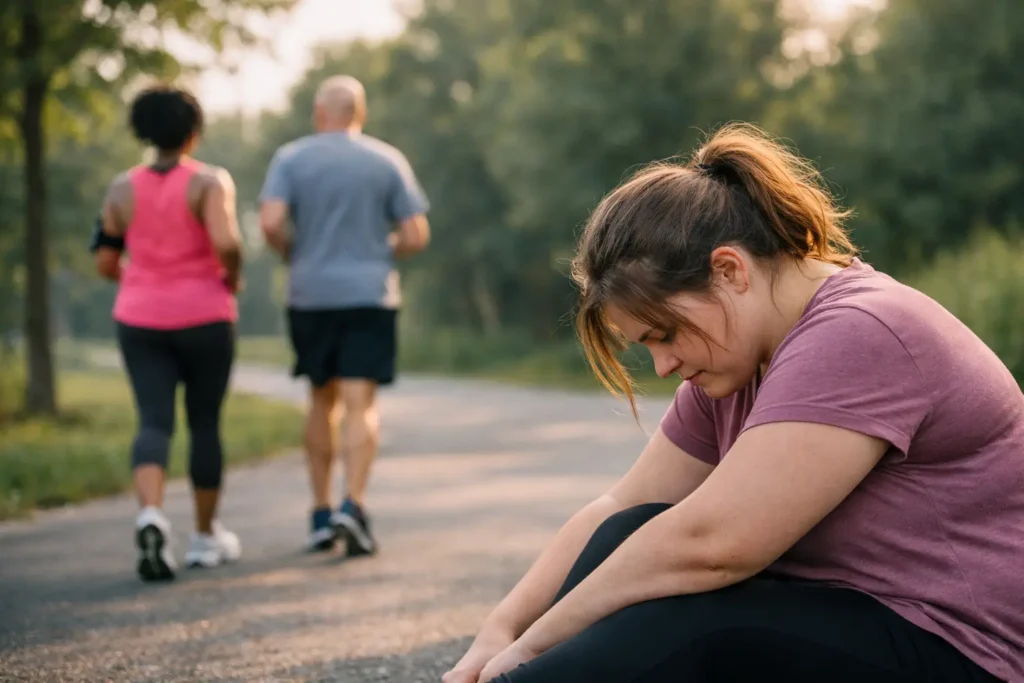
If you have ever stood at the front door in running clothes, already feeling embarrassed before you have even started, you are not overreacting. When people ask why do beginner runners feel ashamed, the answer is usually not laziness, weakness, or a lack of discipline. It is often a mix of comparison, past experiences, body awareness, and the feeling that running belongs to other people.
That feeling can be surprisingly strong. It can show up as putting off your first session, avoiding busy paths, running only when it is dark, or telling yourself you need to get fitter before you are allowed to begin. Shame makes ordinary starting struggles feel personal. Instead of seeing a slow first run as normal, you can end up reading it as proof that you do not belong.
Why do beginner runners feel ashamed in the first place?
A lot of beginner shame comes from the story many people have absorbed about what a runner is supposed to look like. Fast, consistent, lean, confident, and somehow able to glide through every session without stopping. If that is the picture in your head, then a body that needs walking breaks, extra recovery, or a gentler pace can feel like it has failed before it has even begun.
The problem is not you. The problem is that the picture is narrow and unrealistic.
Most new or returning runners do not start from a perfect baseline. They are starting around work, family, fatigue, old injuries, low confidence, illness, menopause, burnout, weight changes, or years of not exercising. They are not arriving with endless energy and no emotional baggage. They are arriving as real people with real lives.
Shame grows in the gap between reality and expectation. If you think running should feel natural straight away, then struggling to breathe, needing to walk, or feeling awkward in public can feel humiliating. In truth, those experiences are common. They are not signs that you are doing it wrong. They are signs that you are at the beginning.
The quiet reasons shame hits beginner runners hard
Sometimes shame is not really about running. Running just brings older feelings to the surface.
School sport and old embarrassment
For many adults, the first memories linked to running are not positive. They are memories of coming last at school, being picked last, being laughed at, or being told they were not sporty. Those moments may have happened decades ago, but the body remembers them. Starting to run again can stir up the same exposed feeling.
That is one reason beginner running can feel far more emotional than it looks from the outside. You are not only doing a new activity. You may also be brushing up against old stories about yourself.
Being visible in a body-conscious activity
Running can feel public in a way that other forms of movement do not. You are outside. People can see you. You may feel slow, red-faced, breathless, sweaty, heavy, awkward, or out of place. Even when other people are barely noticing, shame can make you feel as though you are on display.
This can be especially strong for people in larger bodies, people returning after illness or injury, and anyone whose confidence in their body has taken a hit. There is often a sense that other people will judge not just how you move, but whether you have the right to be there at all.
The belief that walking means failure
This one matters a lot. Many beginners feel ashamed because they think stopping to walk means they are not really running. That belief pushes people into doing too much too soon, then feeling defeated when they cannot sustain it.
Walking is not a sign that you are falling short. For many beginners, it is the reason they can keep going safely and consistently. A walk-run approach lowers the physical and mental load at the same time. It gives your body time to adapt and gives your mind evidence that the session is manageable.
If walking feels embarrassing, it usually says more about the pressure you have absorbed than the quality of your effort.
Shame often sounds like self-protection
One tricky thing about shame is that it often disguises itself as logic.
You might say, I will start once I am fitter. Or once I have lost some weight. Or once I can run for twenty minutes without stopping. Or once I buy the right clothes. These thoughts can sound sensible, but often they are really protective delays. They offer a way to avoid being seen as a beginner.
That makes sense. Shame wants to keep you safe from judgement. The problem is that it also keeps you stuck.
The only way to stop being a beginner is to allow yourself to begin as one.
What helps when beginner running brings up shame?
It usually does not help to lecture yourself out of it. Shame softens faster when you meet it with honesty and a gentler structure.
Start by naming what is happening. Instead of saying, I am pathetic, try something more accurate: I feel exposed because I am new at this. That small shift matters. It moves the feeling out of your identity and into the situation.
Then lower the bar on purpose. Not because you are incapable, but because sustainable beginnings are meant to be modest. A short walk-run session is enough. Ten or fifteen minutes counts. Repeating the same week counts. Going slowly counts. The body does not build confidence from being overwhelmed. It builds confidence from coping.
It also helps to choose conditions that make starting feel possible. That might mean a quiet route, a comfortable time of day, or a very simple session you can remember without checking your mobile every few minutes. Some people feel better beginning with headphones. Others prefer to stay more aware of their breathing and surroundings. It depends on what reduces pressure rather than adding to it.
Most importantly, stop using experienced runners as the measure of whether you are doing well. A person who has been running for years is not your starting line. Your starting line is your own current capacity, on this day, in this season of life.
A better question than why do beginner runners feel ashamed
The question matters, because it helps people realise they are not alone. But after that, a better question is this: what would make running feel safe enough to continue?
For some people, safety means permission to walk. For others, it means a plan that starts gently enough to avoid flare-ups and setbacks. For many, it means being in spaces where slower runners are not treated as a lesser version of the real thing.
This is why beginner-friendly support matters. A calm, walking-first approach changes the emotional experience of starting. It replaces prove yourself with begin where you are. It replaces pressure with structure. It replaces shame with repetition, and repetition is often what slowly rebuilds trust.
That is also why communities built around beginners can feel so different. When people openly talk about missed sessions, nerves, low fitness, sore legs, self-doubt, and starting again, the shame loses some of its power. You stop feeling like the only one who finds this hard. Spaces like Runners Gateway exist for exactly that reason – to make room for a more honest version of running.
You do not need to feel confident to begin
This part is easy to forget. Confidence is not usually the starting point. It is more often the result of repeated, ordinary sessions that did not go perfectly but still happened.
You do not need to wait until your body looks different, your pace improves, or your doubts disappear. You do not need to earn the right to move. If you are starting slowly, using walk breaks, rebuilding after time away, or figuring it out one session at a time, you are not doing a lesser version of running. You are doing the real version that many people actually live.
If shame shows up, it does not mean you should stop. It may simply mean you are doing something tender and brave while still carrying a few old messages that were never yours to keep.
Let your first goal be smaller than pride. Let it be honesty, steadiness, and one session gentle enough that you can come back for another.

