
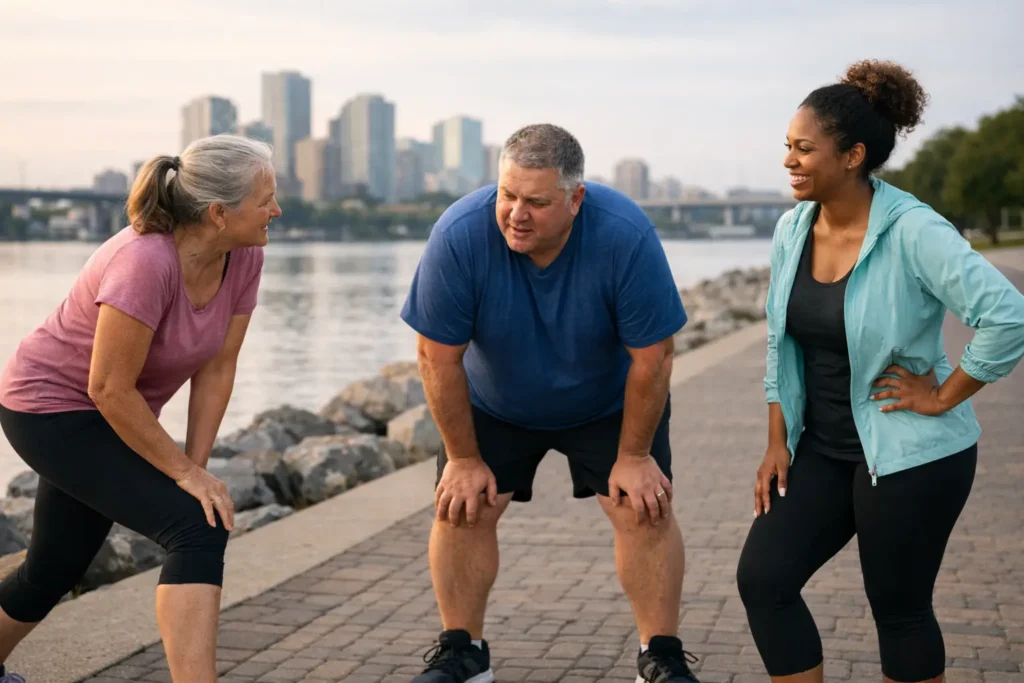
You do not need to get fit before you start running. That belief stops a lot of people before they have even begun. If the idea of running with low fitness makes you feel exposed, behind, or like everyone else got a head start years ago, you are not alone. Plenty of adults come to running from a place of tiredness, doubt, long breaks, injury, illness, or simply feeling a long way from where they used to be.
The good news is that low fitness does not rule you out. It just changes how you begin. A gentler start is not a lesser start. In many cases, it is the smartest one.
For the wider first-step picture, the Getting Started guide explains how to begin at the level that fits today.
What running with low fitness actually means
Low fitness can mean different things. You might get puffed walking up a hill, feel heavy and sluggish after years away from exercise, or worry that your body will not cope. You might also be carrying the frustration of having tried before and stopped.
That matters, because the problem is not only physical. It is often emotional as well. When people say they have low fitness, they are often also saying they have low confidence. They are bracing for embarrassment, discomfort, or proof that they have left it too late.
But fitness is not a fixed identity. It is a starting point. And starting points are allowed to be humble.
Why the usual advice often feels wrong
A lot of running advice still assumes you are already active, reasonably confident, and happy to push through discomfort. If that is not you, much of it feels discouraging from the outset.
Being told to just jog slowly for 20 minutes can sound simple on paper, but for someone rebuilding from low fitness, it can feel impossible. The result is often a hard first attempt, a sore body, a dented confidence, and the familiar thought that running is not for you.
Usually, the issue is not that you failed. It is that the starting point was unrealistic.
A better approach respects your current capacity, not the version of you that exists in your head or in someone else’s training plan.
How to start running with low fitness safely
If your fitness is low, the aim is not to prove toughness. It is to teach your body and mind that this is manageable.
That usually starts with walking. Not as a consolation prize, but as part of the process. Walking prepares your joints, muscles, breathing, and confidence for what comes next. It also helps you build the habit of getting out the door, which is often the hardest part.
Once walking feels settled, short run intervals can be added. That might mean 15 to 30 seconds of easy running followed by a longer walk. Then you repeat. It can feel almost too gentle at first, and that is often a good sign.
You are not trying to smash out a full run. You are building tolerance. There is a difference.
Start smaller than your pride wants to
Most beginners do better when they begin below their maximum, not at it. If you think you could probably manage one minute of running, start with 20 or 30 seconds instead. If 20 minutes feels like a big outing, begin with 10 or 15.
This can feel frustrating if you want faster progress. But there is a trade-off. Starting too hard may give you one satisfying session and then a week of soreness, dread, or a minor niggle. Starting smaller gives you a better chance of coming back again in two days.
Consistency grows fitness more reliably than heroic effort.
Keep the running truly easy
When people are nervous, they often run too fast without realising it. Easy running should feel controlled, even awkwardly slow. You should be able to speak in short sentences. If you are gasping, that is a sign to slow down or return to walking sooner.
This is where many people quietly assume they are failing. They are not. Easy effort is the point. Fitness builds through repeatable work, not through turning every session into a test.
A simple way to structure your first few weeks
For many people, three sessions a week is enough to begin. That gives your body time to recover and adapt. On the days in between, gentle walking is useful if it feels good, but full rest is useful too.
Your sessions might begin with five minutes of walking, followed by short run-walk intervals, then a few more minutes of walking to finish. If week one feels challenging, repeat it. If week two feels rough because life was rough, stay there longer.
Progress is rarely neat. One good week does not mean you should rush ahead. One flat week does not mean you are going backwards.
This is one reason a walking-first method works so well for ordinary people. It makes room for real life, changing energy, and the fact that bodies do not always adapt on a tidy schedule.
What your body may feel in the early stages
You will probably notice puffing, heavy legs, and a strange mix of effort and self-consciousness. That is normal. You may also feel a bit stiff the next day, especially in your calves or hips, particularly if you have been sedentary for a while.
What you do not want is sharp pain, worsening discomfort, or fatigue that lingers and makes each session harder rather than steadier. There is a difference between adapting and overdoing it. If something feels off, it is sensible to ease back, repeat an earlier level, or take extra recovery.
There is no prize for ignoring warning signs.
The mental side of running with low fitness
Often the hardest part is not the breathing. It is the story in your head.
You might feel embarrassed by your pace. You might worry people are watching. You might compare yourself to who you were 10 years ago, or to runners who seem comfortable and confident.
Try to notice when your mind turns running into a performance. For you, right now, this is practice. You are not auditioning for approval. You are building a relationship with movement again.
That shift matters. If each session becomes a judgement, you will dread it. If each session is simply one more vote for your health, confidence, and future, it becomes easier to continue.
Small signs that your fitness is improving
Fitness gains are not always dramatic. In the beginning, the changes are often subtle.
You may recover your breathing more quickly after a run interval. Your walk breaks may feel calmer. You may finish a session thinking, that was not easy, but it was less awful than last time. You may feel a bit more steady on hills, a bit less anxious before heading out, or a bit more willing to try again next week.
Those changes count. They are often the real foundation of progress.
It is also worth remembering that fitness and confidence often rise together. As your body adapts, your self-trust starts to catch up.
When to hold steady instead of progressing
There is a strong temptation to do more as soon as something starts to feel possible. Sometimes that is fine. Sometimes it is exactly how people end up sore, discouraged, and back on the couch wondering what went wrong.
It is often wiser to let a level feel comfortable before moving on. If a session still leaves you wiped out, if your form falls apart halfway through, or if you are dreading the next outing, you probably do not need more. You may simply need repetition.
That slower pace can feel boring if you are eager. But it is often what turns a short-lived attempt into a lasting habit.
You are allowed to begin as you are
There is no perfect threshold you have to cross before running becomes available to you. You do not need to earn your place by getting fitter first, looking a certain way, or proving that you can do it without walking.
Running with low fitness is still running. It may start with short intervals, frequent walk breaks, and plenty of caution. It may be uneven, slower than you hoped, and interrupted by ordinary life. None of that makes it less real.
If you need a calm structure, the walking-first approach used at Runners Gateway is built for exactly this stage. Not to rush you past it, but to help you move through it safely and steadily.
Start where you are. Let walking count. Let slow count. Then keep giving yourself the chance to continue.